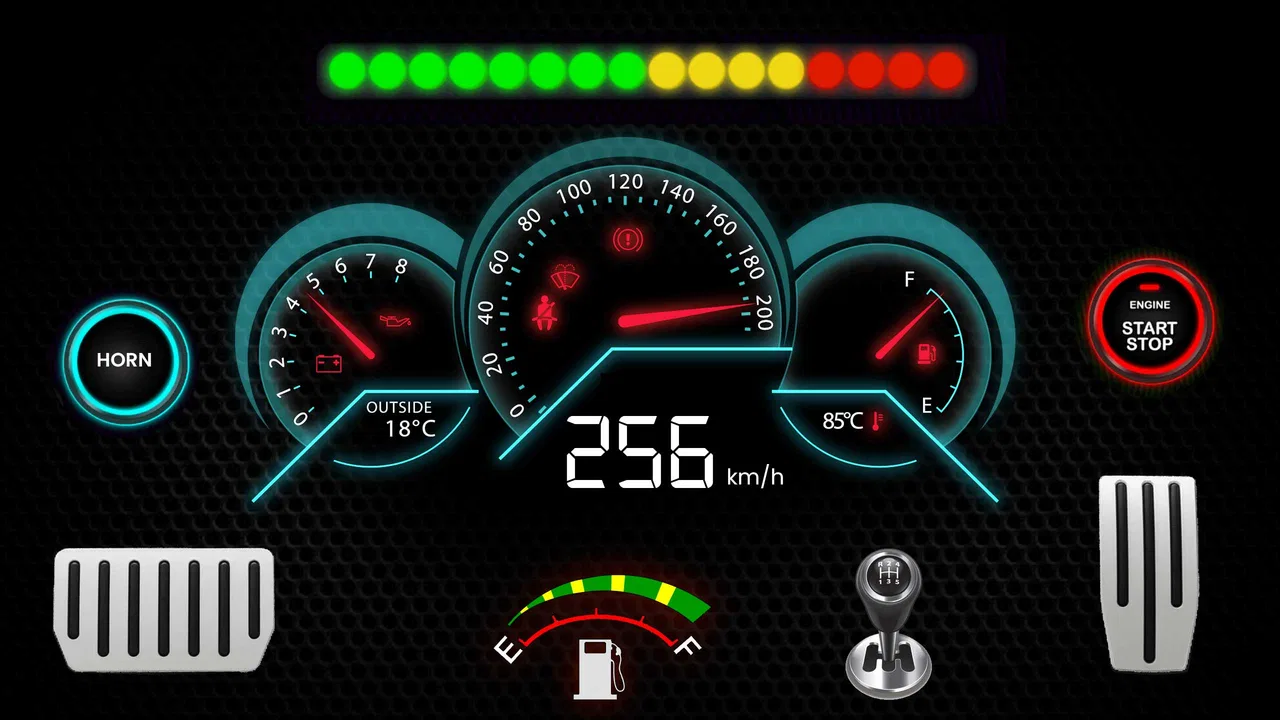
Car Engine Sounds - Gas Pedal
- 4.6
- Rating
- 5.00M
- Installs
- Free
- Price

 Analysis by App-foxy
I approached Car Engine Sounds - Gas Pedal as a small, focused Auto & Vehicles app rather than a full driving simulator. Its purpose is straightforward: let me explore engine and car sounds from my phone, with the gas pedal idea at the center of the experience. That narrow focus is both its appeal and its main limitation. If you enjoy cars, want a playful soundboard, or need something entertaining for a quick break, it can be enjoyable. If you expect realistic driving physics, a complete virtual garage, or a serious vehicle diagnostic tool, this is not the right category of app.
In my experience, the best way to judge it is by asking a simple question: does it make listening to car sounds convenient and fun enough to justify keeping it installed? The answer depends heavily on what you want from your phone. It is free to download, aimed at Everyone, and developed by TarrySoft. The app has reached over a million installs and holds a 4.3 average from around six thousand ratings, which suggests that its basic concept connects with a substantial audience. Those figures do not turn it into a professional automotive tool, but they do place it among the more established casual choices for this kind of entertainment.
What the app feels like in everyday use
The first thing I noticed is how quickly the idea becomes understandable. There is no need to learn a complicated control scheme before trying a sound. The gas pedal concept gives the experience a physical action: instead of simply pressing a track in a list, I can interact with the app as though I were increasing engine speed. That makes it more engaging than a folder of ordinary audio files, especially when I am showing it to someone who likes cars.
You May Also Like

 Blood Strike: 2.5 Anniversary
Blood Strike’s Loadouts Turn Every Drop Into a Tactical Gamble
A close look at Blood Strike’s custom loadouts: how fast access to signature weapons reshapes its battle royale rhythm, rewards preparation, and narrows the gap between fights.

 Pandora - Music & Podcasts
Pandora’s Music Is Easy to Start, but Harder to Recover
Pandora’s strength is its low-effort path from a seed to a station. Its weak spot is how much confidence it asks you to place in connection, setup, and quiet recovery.

 8 Ball Pool
 Is Built on Rivalries, Rematches, and Routine
A close look at the rivalries, rematches, shared routines, and unanswered safety questions that turn a quick pool match into a persistent mobile community.

 Samsung Music
’s Quiet Strength Is Playing What You Already Own
Its reach comes less from spectacle than from dependable access to a personal library. That simplicity is both the app’s strongest retention engine and its ceiling.

 AccuWeather: Weather Radar
AccuWeather Review: A Quick, Clear Forecast for Everyday Decisions
For everyday plans, the best forecast is the one you can understand quickly. AccuWeather makes rain timing, radar, and local conditions easy to act on, with a few trade-offs.

 Hill Climb Racing
Why Hill Climb Racing Still Turns Crashes Into One More Run
A tiny car, a bumpy hill and one more upgrade: Hill Climb Racing keeps resurfacing because its simple chaos makes every near-miss feel personal.
More From Our News Desk
View All News


This also makes it useful in short sessions. I can open it while waiting for a friend, compare a few sounds, or let a child explore the controls under supervision. It works best as a casual toy that creates an immediate reaction. A car enthusiast may enjoy discussing which sound feels more convincing, while someone with no technical knowledge can still understand the basic interaction without reading a manual.
It is important to keep expectations realistic. The app’s store summary presents it as a way for auto lovers to experience car simulator sounds, not as a replacement for a racing game. I would not use it to judge how a real engine behaves, identify a mechanical fault, or recreate the complete experience of driving. The gas pedal interaction adds a sense of participation, but sound alone cannot reproduce acceleration, vibration, road noise, gear changes, or the changing load of a real vehicle.
A practical scenario for sharing the app
A realistic use case is a relaxed gathering where people are comparing favorite cars. Instead of searching through videos and dealing with commentary, I can hand over the phone and let someone try the sounds directly. That makes the app more immediate than a general video platform. It is also less demanding than starting a full racing game, where the person has to navigate menus, choose a vehicle, and learn controls before hearing anything.
There is a useful social detail here: the app can act as a conversation starter, but it should not be treated as an authority. A sound that feels powerful through phone speakers may seem very different through headphones or a car stereo. I found it better for creating an impression than for making precise comparisons. For a more serious discussion about a particular model, an owner review or an in-car recording will usually provide more context.
Who will get the most from it
I would recommend trying it if you enjoy car sounds, want a simple automotive-themed app, or like interactive sound effects. It may also appeal to younger users who enjoy pressing a pedal and hearing an engine respond. Because the content rating is Everyone, it is positioned as accessible rather than mature or specialized, although younger children should still use any sound-focused app at a sensible volume.
The app is less suitable for a person who wants a realistic simulator with steering, braking, traffic, tracks, tuning, or progression. It is also a poor substitute for a vehicle-learning app. Someone researching engine technology will need explanations, diagrams, specifications, and maintenance guidance. This app’s value is sensory and recreational, not educational in a mechanical sense.
Trust, controls, and moments that deserve attention
When I review a simple entertainment app, I still look beyond the main feature. A soundboard can be harmless fun, but the practical experience also depends on what the app asks me to do, how clearly choices are presented, and whether the payment model interrupts the basic activity. Car Engine Sounds - Gas Pedal is free, which lowers the barrier to trying it. At the same time, the app includes in-app purchases ranging from $0.99 to $99.99 per item, so I would not hand over an unlocked phone to a child without checking purchase protections first.
The wide range between the smallest and largest listed purchase is especially worth noticing. It does not automatically mean that spending is necessary, but it does mean the free experience and the optional purchase path should be treated separately. I would begin by using the available core interaction without assuming that every sound or convenience option requires payment. If a purchase screen appears, I would read the wording carefully instead of tapping through quickly.
The safest approach is to test the free experience first, then decide whether any optional purchase adds enough value to justify it. That is more sensible here than buying immediately, because the app’s appeal is easy to evaluate within a short session. If the basic sounds and pedal interaction do not hold my attention, paying for additions is unlikely to change my overall opinion.
Permissions and data-sensitive moments
I pay close attention to permissions and privacy choices when installing any app, but I do not treat a missing explanation as proof of either safety or danger. The responsible approach is to inspect the permission prompts shown on the device, review the app’s current store privacy information, and deny access that does not make sense for the feature I want to use. A car-sound app should be judged by what it visibly requests at installation and during use, not by assumptions about how all apps in the category behave.
The same caution applies to notifications, advertising choices, and purchase prompts. If the app presents a permission request, I would pause and ask whether it is necessary for listening to sounds or using the pedal control. If a request seems unrelated, I would decline it and check whether the main feature still works. This is a useful habit because it preserves my control without requiring me to abandon an app immediately.
Data-sensitive moments can also happen outside the app itself. A purchase may involve the platform account connected to the phone, and a shared device may remember that account. I would use the phone’s purchase authentication, especially when children or guests might access the app. I would also avoid entering personal information into any optional field unless I clearly understood why it was needed and how it would be used.
How much control the user really has
User agency matters more than a polished sound effect. I want to be able to stop a sound, leave the app, control the volume, and refuse optional requests without being trapped in a flow. On my side, the most reliable controls are the operating system’s volume settings, notification settings, permission manager, and purchase authentication. Those tools remain important even when an app itself offers only a compact interface.
For listening, headphones can make the experience more immersive, but they also make excessive volume easier to overlook. I recommend starting quietly and increasing the level gradually. Through a phone speaker, some engine effects may sound thin or compressed; through a car stereo, they may become louder and more dramatic than expected. That difference is not a flaw unique to this app, but it affects how convincing the sounds feel and how carefully I should use them.
One non-obvious trade-off is that convenience and realism pull in opposite directions. A simple pedal control is immediately understandable, but a real engine’s sound changes because of speed, load, gearing, exhaust design, cabin acoustics, and recording conditions. A dedicated driving game may provide more context, while a video platform may provide more authentic recordings. This app wins when I want direct interaction without setup; those alternatives win when I want realism or explanation.
Comparing it with the usual alternatives
Compared with a racing game, Car Engine Sounds - Gas Pedal is faster to start and far less demanding. I do not need to manage a race, learn a track, or spend time unlocking vehicles before getting to the sound-focused part. The trade-off is obvious: there is no reason to expect the depth, visual detail, or sustained challenge of a full game.
Compared with a video platform, the app offers a more controlled and interactive experience. Videos can show real cars, exhaust systems, road conditions, and driver reactions, but they also bring search results, commentary, inconsistent recording quality, and a less direct control method. If I want to hear a real vehicle accelerating on a road, I would choose video. If I want to press a virtual pedal for a quick sound effect, this app is more convenient.
Compared with a music or audio player, it is more specialized and playful. A normal player is better for playlists, background listening, and organized personal files. This app is better when the action of triggering the sound matters as much as the sound itself. That distinction helped me decide where it belongs on my phone: not as an everyday audio utility, but as a compact automotive novelty.
Version, compatibility, and long-term expectations
The current version is 4.1.0, and it supports devices running Android 8.0 or later. That gives it a reasonably broad range of compatibility for people using older Android phones, although performance can still vary with speaker quality, device age, and how the phone handles audio. I would check the device’s available storage and system settings before installing if the phone is already crowded or heavily restricted.
The developer, TarrySoft, has kept the product positioned around a clear theme rather than trying to turn it into an unrelated all-purpose utility. That focus is helpful because I know what I am installing. However, a focused concept can also lose its novelty faster than a larger game. I would expect the app to be most valuable for occasional use unless I genuinely enjoy revisiting different engine effects.
Small habits that improve the experience
I found three practical habits particularly useful. First, I would test the app through the device speaker before moving to headphones or a vehicle’s audio system. That gives me a baseline and prevents an unexpectedly loud output. Second, I would use the app in short comparison sessions instead of leaving it running in the background; the interaction is more enjoyable when I am actively listening rather than treating it as continuous ambience.
Third, I would separate entertainment from identification. If a sound reminds me of a particular car, I would treat that as a fun impression, not confirmation that the app reproduces that vehicle accurately. This prevents disappointment and avoids using a novelty soundboard for decisions about buying, repairing, or evaluating a real car.
A fourth useful habit concerns purchases. I would explore the free portion while signed out of impulse mode, meaning I would not keep a payment prompt open while casually tapping through sounds. On a family device, I would enable authentication for every purchase and explain that free installation does not necessarily mean every optional item is free. That simple boundary protects the user’s budget while preserving the app’s recreational value.
My cautious verdict after using it
Car Engine Sounds - Gas Pedal succeeds when I judge it as a compact interactive sound experience. It is easy to understand, quick to open, and specific enough to appeal to people who enjoy automotive audio. The pedal-style interaction gives it more personality than a static collection of sound buttons, and the free entry point makes it reasonable to try before deciding whether it deserves a permanent place on the phone.
My reservations are just as clear. It should not be confused with a driving simulator, a technical reference, or a realistic recording archive. The sound experience will depend on the phone and listening setup, and the optional purchase range means I would pay attention to every purchase screen. I would also review permissions and privacy choices directly on the device rather than making assumptions based on the app’s category.
For me, the final decision is simple: I would recommend it to a car fan who wants a quick, playful way to trigger engine sounds, especially when sharing the phone with friends. I would skip it if my goal were serious simulation, detailed car education, or authentic real-world recordings. Its strongest quality is immediate automotive fun, not depth; as long as I install it with that expectation and keep control of permissions, volume, and purchases, it is a reasonable free app to explore.
With an Everyone content rating and a broad Android compatibility range beginning with Android 8.0, it is accessible to many casual users. The 4.3 average from around six thousand ratings and more than a million installs indicate that the concept has found an audience, while the app’s focused design explains why. I would keep it for occasional sound experiments rather than daily use, and I would recommend the same honest test to anyone considering it: try the free interaction, check the visible choices, listen at a safe level, and decide based on whether the sounds themselves remain enjoyable after the first novelty wears off.
FAQs for Car Engine Sounds - Gas Pedal
01What is the main purpose of the Car Engine Sounds - Gas Pedal app?
The Car Engine Sounds - Gas Pedal app is designed to simulate realistic car engine sounds for car enthusiasts and those curious about different engine noises. It provides users with an immersive audio experience by allowing them to rev various car engines through their smartphones, offering an authentic feel without needing to own the cars themselves.
02Is the Car Engine Sounds - Gas Pedal app free to use?
The app is free to download, but it may offer in-app purchases or premium versions. These options often include additional engine sounds or enhanced features, providing a richer user experience. It’s advisable to check the app store description for detailed pricing information and any available features in the free version.
03What types of car engines can I expect to find in the app?
The app includes a diverse range of engine sounds from various car models, including sports cars, muscle cars, and luxury vehicles. Users can explore these engine noises to compare the differences between them. The selection may be updated periodically, ensuring a fresh and varied experience for users interested in automotive sounds.
04How user-friendly is the Car Engine Sounds - Gas Pedal app for beginners?
The app is designed with an intuitive interface, making it accessible for users of all ages and experience levels. With simple controls, users can easily navigate through the different engine sounds and adjust settings. Beginners will find it straightforward to use, while car enthusiasts will appreciate the attention to detail in the sound simulation.
05Does the Car Engine Sounds - Gas Pedal app require an internet connection?
While some basic features may be available offline, a stable internet connection is usually required to access the full range of engine sounds and any additional content. This ensures that users receive the most up-to-date features and sounds, enhancing the overall experience. Check the app’s requirements for specific offline capabilities.
Pros
- Authentic engine sounds enhance realism.
- Wide variety of car models available.
- Easy-to-use interface for all ages.
- Offline mode for uninterrupted play.
- Regular updates with new features.
Cons
- Limited customization options for sounds.
- Ads can be frequent and intrusive.
- Sound quality varies between models.
- No multiplayer or social features.
- Requires significant storage space.

Car Engine Sounds - Gas Pedal
Gallery